Sustainable Performance - 322 - Master's Year 2

Syllabus

Mandatory Courses

  • Introductory seminar

    Introductory seminar

    Lecturer :

    Total hours : 6

    Overview :

    During this introductory seminar, we will define sustainability and situate the concept in a socio-historical perspective. A business case led by our corporate partner CGI on public transport organization will introduce CSR stakes as a transversal matter.

    Coefficient : VAL

    Learning outcomes :

    - Understand organizational stakes of CSR

    - Apprehend the role of management control in implementing and controlling CSR policies

  • Sustainable Finance

    Sustainable Finance

    Ects : 6

    Lecturer :

    • Laurent PAYET

    Total hours : 21

    Overview :

    Course in partnership with Grant Thornton

    Coefficient : 1,25

  • Accounting for sustainability

    Accounting for sustainability

    Ects : 6

    Lecturer :

    Total hours : 21

    Overview :

    Session 1 : Introduction

    Session 2 : Carbon accounting

    Session 3 : Materiality analysis

    Session 4 : Modelisation of the (un)sustainability

    Session 5 : Monetarisation of the issues

    Session 6 : SEA and Democracy

    Coefficient : 1,25

    Learning outcomes :

    At the end of this course, you should be able to advise a company on setting up an social and environmental accoutning model tailored to its needs. This include to be able to :

    • Analyse the existing accounting modelisation
    • Discuss their approach of sustainability
    • Organize the identification of the main sustainability issues
    • Organize the data collection and indicators production
    • Present the organization’s (or project’s) sustainable performance

    Assessment :

    Case study and an executive summary to be written

  • European Regulation for sustainability

    European Regulation for sustainability

    Ects : 3

    Lecturer :

    • LEO VAN DEN BUSSCHE

    Total hours : 24

    Overview :

    Two units:

    • Lobbying for sustainable development
    • Introduction to environmental law for managers

    Coefficient : 1

    Learning outcomes :

    - Articulate control problematics at regulation - organizational level

    - Understand the influence of lobbying practices for sustainability

    - Acquire a basic toolkit for legal aspects of environmental law in organizations

    Assessment :

    Rédaction d'une dissertation sur un thème en lien avec le droit de l'environnement validé par le professeur.

    Bibliography-recommended reading

    Meynier, A. (2016). La notion de mouvement en droit de l’environnement. Revue Juridique de L Environnement, 41(3), 425-438. doi.org/10.3406/rjenv.2016.6887

    Van Lang, A. (2025). Droit de l’environnement.

  • Organizational approach to ecological transition

    Organizational approach to ecological transition

    Ects : 3

    Lecturer :

    Total hours : 18

    Overview :

    This class aims at giving theorical tools to better understand change in organizations. After an overview of change management, 6 different bodies of theory will be presented to students. These theories are meant to help future managers identify the different aspects of organizations to better accompany change in organizational strategies, goals and cultures towards more sustainable practices.

    Coefficient : 1

    Learning outcomes :

    - Understand how organization theories help us decrypt organizational change

    - Develop reflexive thinking

    Assessment :

    50% Participation in class. This grade relates to class preparedness, presentations or participation for correction of case studies as well as general implication during sessions.

    50% Individual assessment

    Choosing among 2 mini case studies, you will confront how two different theories presented in class can highlight different aspects of the case.

    Cases will be given during the last session.

  • Audit RSE

    Audit RSE

    Ects : 3

    Lecturer :

    Total hours : 21

    Overview :

    Ce cours propose aux étudiants de comprendre les principales étapes et outils de l'audit de la CSRD. Il propose ce faisant une interprétation de la CSRD par le prisme de l'auditeur en mettant en lumière les enjeux de cette interprétation du point de vue de la structuration des pratiques.

    Coefficient : 1,25

    Learning outcomes :

    Ce cours doit permettre aux étudiants d'appréhender :

    • la méthodologie d'audit
    • l'approche par les risques de l'auditeur
    • la vérification de l'analyse de double matérialité
    • les outils de contrôle de la conformité
  • Governance

    Governance

    Ects : 3

    Lecturer :

    • GEORGES CHAPPOTTEAU

    Total hours : 18

    Overview :

    This course will introduce how governance relates to strategies in the organization and how they can impact management. Specifically, different type of organizations and recent denominations such as mission-led companies or B-Corp come with specific responsibilities for organizations.

    Coefficient : 1

    Learning outcomes :

    - Understand the different governance structures and how they relate to CSR obligations

    - Identify and recommend strategies for governance

  • Management control for sustainability

    Management control for sustainability

    Ects : 3

    Lecturer :

    Total hours : 15

    Coefficient : 1.25

  • Méthodologie du mémoire

    Méthodologie du mémoire

    Lecturer :

    Total hours : 6

    Overview :

    This course provides a methodology to help students construct their research proposal for their master's dissertation. It will cover the structure of the dissertation, explain how to conduct research for academic articles and expose different data analysis methods.

    Learning outcomes :

    - Conduct an online academic research for articles

    - Construct a problematic

    - Design a research proposal, with adequate correspondance between problematic and methodology

  • Retournement d'entreprise

    Retournement d'entreprise

    Ects : 6

    Lecturer :

    Total hours : 25

    Overview :

    Cet enseignement, en partenariat avec l'ARE (l'Association pour le Retournement des Entreprises), de déroule sur le semestre sous le mode projet.

    Après deux jours intensifs d'enseignements sur les différents aspects du retournement des entreprises (aspects audit, juridiques, management de transition, relations bancaires, communication de crise), les étudiants sont répartis en équipe de 5 personnes environ. Chaque équipe se voit attribuée un cas réel d'entreprise qui a connu des difficultés. Epaulée par un coach, spécialiste du retournement des entreprises et membre de l'ARE, chaque équipe va, au cours du semestre, faire un diagnostic des difficultés de l'entreprise et proposer un plan de retournement. A la fin du semestre, chaque équipe présente son plan de retournement devant un jury de 8 membres dont un est membre du comité de direction de l'entreprise qui a connu des difficultés et est parvenue à se retourner.

    Coefficient : 6 ECTS Coefficient 2 (M2 Conseil et recherche en audit et contrôle) 3 ECTS Coefficient 3 (M2 Financial control) 3 ECTS Coefficient 2 (M2 Contrôle, Gouvernance et Stratégie)

    Learning outcomes :

    Identifier les problèmes d'une entreprise en grandes difficultés.

    Proposer des scenarii de sortie de crise qui prennent en compte les intérêts des parties prenantes (fournisseurs, banque, salariés, actionnaires)

    Assessment :

    30% sur la dynamique de l'équipe

    30% sur le dossier préliminaire

    40% sur le plan de retournement proposé au jury final

Mandatory Courses

  • Politique RSE en entreprise

    Politique RSE en entreprise

    Ects : 3

    Total hours : 18

    Coefficient : 1

  • Sustainability at work

    Sustainability at work

    Ects : 3

    Total hours : 18

    Coefficient : val

  • Public Managment

    Public Managment

    Ects : 3

    Lecturer :

    Total hours : 15

    Coefficient : 1

  • Institutional integrity

    Institutional integrity

    Ects : 3

    Lecturer :

    • CEDRIC BOURGEOIS

    Total hours : 18

    Coefficient : 1

  • Financial institutions and ecological transition

    Financial institutions and ecological transition

    Ects : 3

    Lecturer :

    • YANNICK LUCOTTE

    Total hours : 18

    Overview :

    - Investment matters (ESG, balance sheet decarbonation...) - Ethical matters (credits etc.) - Control systems in banking

    Coefficient : 1,25

    Learning outcomes :

    - Understand sustainability stakes in banking

  • CSR Reporting

    CSR Reporting

    Ects : 3

    Lecturer :

    Total hours : 21

    Overview :

    This course reviews the various rules and regulations regarding sustainability reporting with a focus on GRI framework, IFRS sustainability standards, the European regulations (CSRD, ESRS).

    The course insists on the diverse conceptions and orientations of CSR and sustainability reporting and tries to offer a critical analysis of CSR guidelines and regulations

    • Through the confrontation with CSR reporting practices (CSR reports)
    • Through a comparative analysis with financial reporting

    Coefficient : 1,25

    Recommended prerequisites :

    A course on the basics of financial reporting is recommended.

    Learning outcomes :

    The aim of the course is to allow students to get acquainted with the various guidelines, regulations and standards of CSR reporting.

    • In a historical perspective: from soft guidelines (GRI, …) to compulsory rules (CSRD, ESRS)
    • Through a variety of viewpoints (standard-setters / preparers / users) and orientations
    • Through the various dimensions of CSR (Environmental, Social, Governance)

    Following this course, students should be familiar with the various guidelines and regulations related to CSR reporting.

    Assessment :

    Continuous assessment: 50 % (oral présentation + participation)

    A terminal examination: 50 % (analysis of a CSR report)

  • Transversal seminar (PSL Weeks)

    Transversal seminar (PSL Weeks)

    Ects : 3

    Total hours : 24

    Coefficient : VAL

  • Soft skills + HR for managers (FR)

    Soft skills + HR for managers (FR)

    Ects : 3

    Total hours : 18

    Overview :

    Learning to recognize your motivational levers

    Coefficient : VAL

    Learning outcomes :

    Learning to recognize your motivational levers

  • Dissertation

    Dissertation

    Ects : 6

    Overview :

    The master's dissertation provides students with the opportunity to investigate in-depth a problematic based on both academic research and fieldwork. It enables students to become experts on a domaine, and link their professional experience with the academic outcomes of the program.

    Coefficient : 1,25

    Learning outcomes :

    - Develop a research proposal

    - Academic writing in English

  • Internship

    Internship

    Overview :

    Internship of 4 to 6 months, mandatory, in France or abroad Students with a permanent job offer are exempted from completing an internship

    Coefficient : VAL

    Learning outcomes :

    Professional induction

Academic Training Year 2026 - 2027 - subject to modification

Teaching Modalities

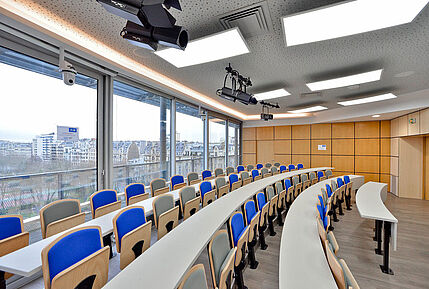
This program, only in initial training, lasts for 368 hours across both semesters. The program is held full time at the Paris Dauphine campus. The first semester lasts from September to December and the second semester from January to March, followed by an internship. The program is mostly taught in English. However, in order to get the most out of our project-based pedagogy, business projects in partnerships with corporations are taught in French.

Program specificities:

  • Courses taught by corporate partners (such as Mazars and Grant Thornton, Carbone sur Factures), academic specialists and professional experts of their field
  • Project-based pedagogy: restructuring, carbon accounting, consultancy projects, CSR implementation.
  • Master’s dissertation to bridge problematics from the internship with theoretical knowledge
  • Mandatory internship of 4 to 6 months (except if permanent job offer)
  • Participation in a class trip

Internships and Supervised Projects

Initial training track’s students must complete a 3 to 6 months long internship which can take place abroad to further the international benefits of this English-taught program.

Students with a permanent job offer can be exempted from this internship.

Students participate in a class-wide project based on real business cases for turning around companies.

Research Support


Research-driven Programs 

Training courses are developed in close collaboration with Dauphine's world-class research programs, which ensure high standards and innovation. 
Research is organized around 6 disciplines all centered on the sciences of organizations and decision making.

Learn more about research at Dauphine